
Is PK’s Bankipur win a “Flash in the Pan”, or Is he cooking something big?
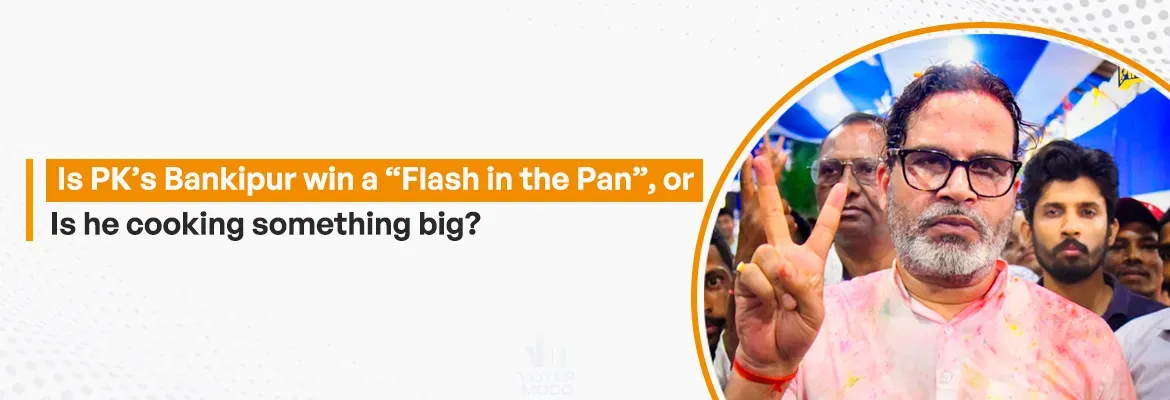
Prashant Kishor’s victory in the Bankipur Assembly bypoll has done something few would have imagined possible just months ago: it has shaken one of the BJP's most impregnable political fortresses in Bihar.
Bankipur was not merely another BJP stronghold. The party had been winning the seat continuously since 1995, nine consecutive victories. In the November 2025 Assembly election, BJP candidate Nitin Nabin had secured a formidable 62.7% of the vote, while Vandana Kumari of Prashant Kishor’s Jan Suraaj Party (JSP) could manage only 4.9%.
Yet, in the subsequent by-election, the political script was dramatically rewritten.
Prashant Kishor’s candidate secured 49.2% of the vote, defeating BJP’s Neeraj Kumar Sinha, who received 34.4%. RJD was pushed into a distant third place, with Rekha Kumari polling just 10.9%.
The numbers tell a story of an extraordinary political turnaround. But the larger significance of Bankipur may lie beyond the victory itself.
From BJP Fortress to Political Earthquake
For nearly three decades, Bankipur had acquired the reputation of an impregnable BJP bastion. A party that had held the seat continuously since 1995 was suddenly defeated in a by-election by a relatively new political formation.
That makes the result more than a routine electoral upset.
The BJP’s decline from 62.7% in the November 2025 election to 34.4% in the bypoll is particularly striking. Even allowing for the differences between a general Assembly election and a by-election, the scale of the swing indicates that something significant changed in the political equation within a matter of months.
The question is not simply why the BJP lost Bankipur. The more interesting question is: what made voters willing to abandon a decades-old political habit?
Is Bihar Looking for a Third Alternative?
The most important message from Bankipur could be the emergence of political space between the BJP and the RJD-led opposition.
For years, Bihar politics has largely been understood through the prism of two principal poles: the Nitih Kumar- BJP-led camp on one side and the RJD-led social and political coalition on the other.
Prashant Kishor has been attempting to challenge that binary through Jan Suraaj. Until recently, however, the electoral evidence suggested that the project had struggled to translate its political messaging into votes.
Bankipur changes that conversation.
The result suggests that at least in some constituencies, voters may be willing to experiment with a third political alternative if they believe it can defeat an established party while offering something different from the traditional opposition.
The RJD's performance is equally significant. With only 10.9% of the vote, it was not merely defeated; it was pushed into a position of political irrelevance in this particular contest.
That does not mean the RJD is irrelevant across Bihar. But Bankipur demonstrates that the space traditionally occupied by the principal opposition is not necessarily secure.
The Extraordinary Prashant Kishor Turnaround
Perhaps the most remarkable aspect of the Bankipur result is the speed of the turnaround.
In the November 2025 Assembly election, Jan Suraaj received only 3.4% of the vote across Bihar. Of the 238 candidates fielded by the party, only two managed to save their deposits.
By any conventional electoral measure, those numbers suggested a political movement struggling to establish itself.
And then came Bankipur.
Within a few months, a party that had appeared electorally marginal managed to win nearly half the votes in one of the BJP's strongest constituencies.
That is an astonishing transformation.
It would be tempting to interpret this as proof that Prashant Kishor has suddenly discovered the formula for electoral success. But that would be premature. One constituency, and particularly one by-election, cannot establish a statewide political trend.
What it does establish is something equally important: Jan Suraaj can no longer be dismissed simply as an electoral experiment with no immediate political traction.
Why the By-Election Matters
By-elections are unusual political laboratories.
They are often influenced by local factors, candidate selection, voter mobilisation, government performance, personal equations and the circumstances surrounding the vacancy. Therefore, the Bankipur result cannot automatically be extrapolated to every Assembly constituency in Bihar.
But by-elections can also reveal something that large elections sometimes conceal: the willingness of voters to break established patterns.
Bankipur's importance lies precisely in this disruption.
A BJP seat that had remained in the party's column since 1995 changed hands. The BJP's vote share fell sharply. The RJD failed to emerge as the principal beneficiary. And a relatively new political force emerged as the winner.
That combination is what makes the result politically consequential.
A Warning for the BJP
For the BJP, Bankipur should be viewed as a warning rather than merely an isolated defeat.
The party's nine consecutive victories had created the impression of a deeply entrenched electoral base. The November 2025 result, with Nitin Nabin winning 62.7%, appeared to reinforce that perception.
The bypoll has demonstrated that even a strong organisational and historical advantage can be vulnerable to a sufficiently large shift in voter preferences.
The BJP will therefore have to ask whether the Bankipur result was driven primarily by local circumstances or whether it reflects a broader dissatisfaction among sections of urban and middle-class voters.
If the latter is true, the emergence of Jan Suraaj could force the BJP to deal with a new competitor rather than simply fight its traditional electoral battles.
And a Bigger Problem for the RJD
The result could arguably be even more unsettling for the RJD.
The traditional logic of anti-BJP politics would suggest that a decline in the BJP's support should benefit the principal opposition party. Bankipur produced the opposite outcome.
Instead of the RJD capturing the anti-BJP vote, Jan Suraaj appears to have occupied much of that political space.
The RJD's 10.9% vote share raises uncomfortable questions about whether sections of voters who want an alternative to the BJP necessarily see the RJD as their preferred vehicle.
If this pattern were to spread beyond Bankipur, it could complicate Bihar's established two-pole political structure.
From Election Strategist to Political Challenger
Prashant Kishor's political journey makes the Bankipur result particularly intriguing.
He entered public life with an enormous reputation as an election strategist who had worked with major political leaders and parties. But converting the reputation of a political strategist into an independent electoral movement was always going to be a far more difficult task.
The 2025 Assembly election appeared to demonstrate that difficulty.
Jan Suraaj's 3.4% statewide vote share and its inability to save deposits in all but two of the 238 constituencies suggested that organisational reach and electoral credibility could not be built overnight.
Bankipur, however, provides Kishor with something his movement desperately needed: a tangible electoral success story.
A victory in a BJP fortress gives Jan Suraaj not only a seat but also a narrative.
And in politics, narrative can be an organisational asset.
The Psychological Impact May Be Bigger Than the Seat
The most important consequence of Bankipur may not be the number of seats Jan Suraaj has won. It may be the psychological impact of the victory.
Political parties are sustained not only by votes but also by perceptions of winnability.
For years, voters may have believed that voting for a smaller party was unlikely to produce a meaningful electoral outcome. Bankipur challenges that assumption.
The message from the constituency is simple: a new political force can win.
That can influence future candidates, donors, workers and, most importantly, voters.
A single victory can create the perception that a party has crossed the threshold from protest politics to competitive politics.
Whether Jan Suraaj can sustain that perception is now the central question.
Is Prashant Kishor a Flash in the Pan or a Horse for the Long Race?
This is where caution is necessary.
One spectacular by-election victory does not make a statewide political force.
Bihar is a complex electoral landscape, shaped by caste alliances, local networks, personalities, welfare politics, organisational machinery and deeply rooted political loyalties. Jan Suraaj still has to demonstrate that it can build a durable organisation, attract credible candidates and replicate its Bankipur performance across very different constituencies.
Its performance in the 2025 Assembly election remains a reminder of how difficult that task will be.
So, is Prashant Kishor a flash in the pan or a horse for the long race?
For now, there is no definitive answer.
But Bankipur has ensured that the question can no longer be dismissed with a shrug.
The Political Class Has Been Put on Notice
The biggest significance of the Bankipur bypoll is therefore not that Prashant Kishor has suddenly become a dominant force in Bihar.
He has not yet.
The significance is that he has demonstrated the possibility of something that Bihar's established political players may have underestimated: the existence of an appetite for an alternative political vehicle.
The BJP has lost a fortress it had held since 1995. The RJD has failed to capitalise on the BJP's decline. And Jan Suraaj has gone from 4.9% in Bankipur in November 2025 to 49.2% in the bypoll in just a few months.
That is not a routine electoral fluctuation. It is a political shock.
Whether it becomes the beginning of a larger realignment or remains an extraordinary one-off will depend on what Prashant Kishor does next.
For the moment, however, the verdict from Bankipur is clear: Bihar's political establishment has been put on notice.

VoterMood is a platform for democratic engagement. Information on this platform is meant for public awareness and participation. Users are encouraged to engage responsibly and respect democratic principles.

2026 © VoterMood - Powered by  Zentek Infosoft.