
BMC Polls: A Do-or-Die Battle for Shiv Sena (UBT) & Raj Thackeray
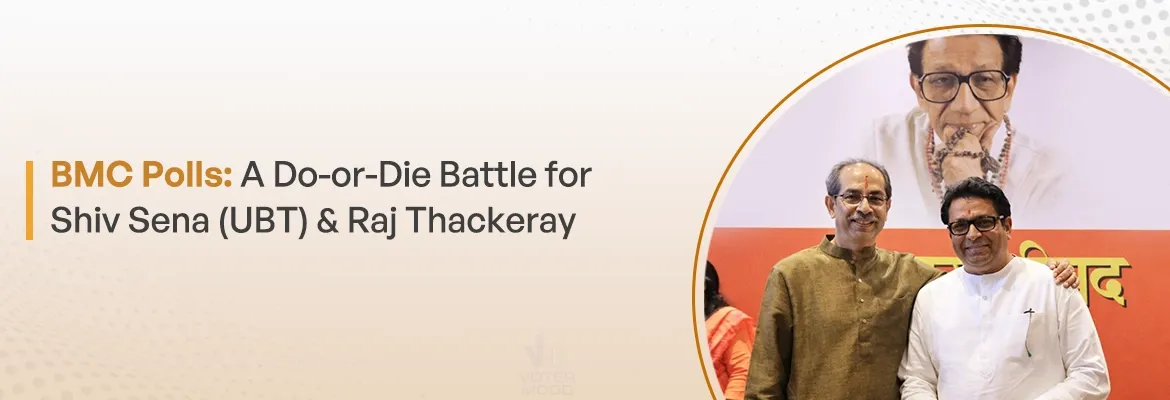
The Brihanmumbai Municipal Corporation (BMC) election has emerged as one of the most consequential political contests in Maharashtra. Far more than a routine civic poll, it is widely seen as a referendum on leadership, legacy, and survival especially for Shiv Sena (Uddhav Balasaheb Thackeray) and Maharashtra Navnirman Sena (MNS) chief Raj Thackeray. With Mumbai being the state’s financial and political nerve centre, the outcome is expected to influence the broader trajectory of Maharashtra politics.
UBT’s Toughest Test After the Split
For Shiv Sena (UBT), the BMC election is arguably the biggest political examination since the party split in June 2022. It is Uddhav Thackeray’s third major electoral battle after losing control of the party name and symbol. The stakes are deeply emotional and political. The undivided Shiv Sena ruled the BMC for nearly 25 years, making Mumbai its strongest fortress. Regaining control of the civic body is crucial for Uddhav Thackeray to prove that his faction still commands the Sena’s traditional support base.
Why the BMC Matters So Much
The BMC is not just India’s richest municipal corporation; its budget surpasses that of several small states. The last election was held in February 2017, and the long delay has only heightened political tension. Control over the BMC provides enormous administrative power, financial resources, and grassroots influence making it a launchpad for state-level ambitions.
Also Read: Uddhav Thackeray Biography: Early Life, Education and Political Career
The Sena + MNS Reunion: Emotion vs Reality
In a bid to consolidate the Marathi vote, Uddhav Thackeray has forged an alliance with his cousin Raj Thackeray’s MNS. The reunion carries strong emotional symbolism, considering Raj quit Shiv Sena in 2005 and formed MNS in 2006. For Raj Thackeray too, the election is do-or-die. After years of limited electoral success, the BMC offers him a chance to reassert relevance in Mumbai’s politics. Yet, while the alliance appeals to Marathi sentiment, questions remain over its actual vote-conversion capacity on the ground.
A Reality Check on Past Performance
Despite its long rule, Shiv Sena never secured a clear majority in the BMC on its own. In 1985, it won 74 of 170 seats. Its best performance came in 1997 with 103 of 221 seats. Thereafter, the tally steadily declined, reaching 84 seats in 2017. These numbers underline the scale of the challenge before Sena (UBT).
The Verdict Beyond Mumbai
Ultimately, the BMC election will decide more than civic control. For Uddhav Thackeray, it is about political legitimacy after the split. For Raj Thackeray, it is a battle for survival and relevance. And for Maharashtra, it could well redraw the balance of power in the years ahead.

VoterMood is a platform for democratic engagement. Information on this platform is meant for public awareness and participation. Users are encouraged to engage responsibly and respect democratic principles.

2026 © VoterMood - Powered by  Zentek Infosoft.