
Battle for Supremacy: Why West Bengal Matters to Both TMC and BJP
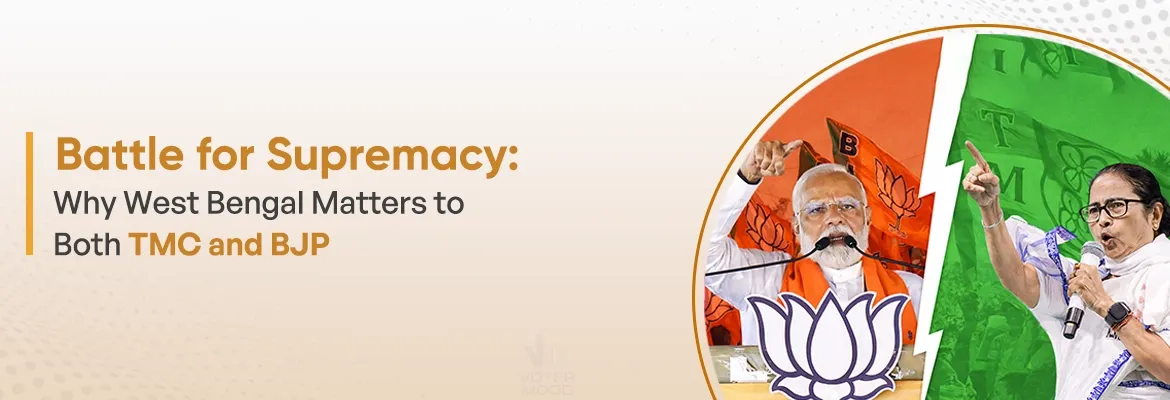
West Bengal has emerged as one of the most fiercely contested political battlegrounds in India, symbolising a larger struggle for dominance between the Trinamool Congress (TMC) and the Bharatiya Janata Party (BJP). The contest is no longer limited to state power alone; it has evolved into a high-stakes fight that carries deep political, ideological, and strategic significance for both parties.
TMC’s Fortress and Mamata Banerjee’s Political Legacy
For the Trinamool Congress, retaining West Bengal is synonymous with political survival and relevance at the national level. Chief Minister Mamata Banerjee has built her political identity as the undisputed leader of the state, positioning herself as a formidable opponent of the BJP’s centralised politics. A victory in Bengal reinforces her image as a mass leader who can defeat the BJP on her home turf and strengthens her claim as a key face of opposition unity.
Losing Bengal would not only weaken the TMC’s organisational base but also dent Mamata Banerjee’s authority, both within the state and beyond. The party’s governance record, welfare schemes, and strong grassroots network are all under scrutiny, making the election a referendum on Mamata’s leadership.
BJP’s Eastern Ambition and National Narrative
For the BJP, West Bengal represents unfinished business and a gateway to expanding its influence in eastern India. Despite repeated setbacks, the party has steadily increased its vote share and organisational presence. Winning Bengal would be a major political breakthrough, proving the BJP’s ability to dislodge strong regional parties and extend its dominance beyond its traditional strongholds.
A BJP victory would significantly alter the national political narrative, signalling the erosion of regional satraps and strengthening the party’s claim of being the principal pole of Indian politics. It would also provide the BJP with a strategic base to influence neighbouring states in the east and northeast.
Also Read: Mamata Banerjee Biography: Early Life, Education and Political Career
Ideology, Identity, and Polarisation
The Bengal contest is also shaped by competing narratives—regional pride versus national integration, welfare politics versus development claims, and cultural identity versus ideological mobilisation. Issues such as federalism, law and order, and social cohesion have sharpened the political divide, making the election emotionally charged and highly polarised.
A Verdict with National Consequences
The outcome in West Bengal will resonate far beyond the state’s borders. A TMC win would energise the opposition and reaffirm the relevance of strong regional leadership. A BJP victory, on the other hand, would mark a historic political shift, reshaping power equations and reinforcing the party’s national ascendancy. In many ways, Bengal has become the mirror reflecting India’s larger political future.

VoterMood is a platform for democratic engagement. Information on this platform is meant for public awareness and participation. Users are encouraged to engage responsibly and respect democratic principles.

2026 © VoterMood - Powered by  Zentek Infosoft.