
Rajasthan Politics in 2025: Environment, Ethics and Electoral Uncertainty
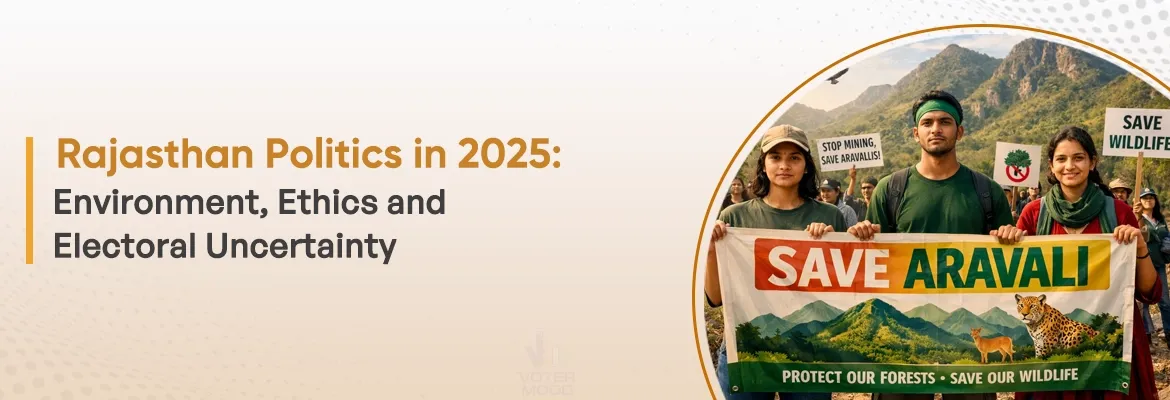
Rajasthan’s political discourse in 2025 has been shaped by a convergence of environmental controversy, allegations of corruption against elected representatives, and growing unease over democratic processes. From the Aravalli hill range debate to a sensational sting operation and prolonged delays in local body elections, the year has tested the credibility and priorities of the state’s political leadership.
Aravalli Controversy Puts Environment at the Centre of Politics
The redefinition of the Aravalli hill range has emerged as one of the most contentious political issues in Rajasthan this year. The revised definition, which limits Aravalli protection to hills rising over 100 metres, has drawn sharp criticism from opposition parties, environmentalists and civil society groups. Critics argue that the move effectively removes protection from nearly 90 per cent of the Aravalli landscape in Rajasthan, paving the way for mining, real estate and industrial projects.
The Congress has accused the BJP-led state government of weakening environmental safeguards under pressure from corporate interests. Street protests, memorandums to the Governor and sustained campaigns under the banner of “Save Aravalli” have kept the issue alive, particularly in regions dependent on the hills for water security and livelihoods.
Also read: ये नई भाजपा है ….A party comfortable with surprise choices
Sting Operation Against MLAs Triggers Political Storm
Adding to the turbulence was a sting operation that surfaced late in the year, allegedly showing three sitting MLAs from different political backgrounds demanding commissions for sanctioning development works under the MLA Local Area Development scheme. The revelations sparked outrage, forcing the state government to order a high-level inquiry and freeze the legislators’ discretionary funds.
While the accused MLAs have denied wrongdoing and questioned the authenticity of the videos, the episode has once again raised uncomfortable questions about corruption, ethics and accountability in Rajasthan’s political system.
Delay in Local Body Elections Raises Democratic Concerns
Another major flashpoint has been the continued delay in municipal and local body elections. Opposition parties have accused the state government of deliberately postponing polls to avoid political backlash, particularly in urban areas facing civic issues such as water shortages, sanitation failures and rising taxes.
The absence of elected local representatives has led to administrative paralysis in several municipalities, with bureaucratic control replacing grassroots governance. The delay has also prompted legal scrutiny and criticism from constitutional experts, who warn that prolonged postponement undermines democratic decentralisation.
A Politically Charged Road Ahead
As Rajasthan moves into 2026, these issues environmental protection, political integrity and democratic accountability are likely to dominate public debate. Together, they reflect a state grappling not just with governance challenges, but with deeper questions about the direction of its politics.

VoterMood is a platform for democratic engagement. Information on this platform is meant for public awareness and participation. Users are encouraged to engage responsibly and respect democratic principles.

2026 © VoterMood - Powered by  Zentek Infosoft.